|
| ||||||||||
THE COMPANY |


|
The
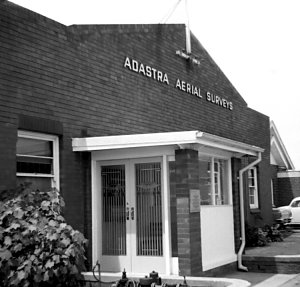
Adastra building at
41-43 Vickers Avenue, Mascot on 11th January 1965. Photo: Ron Cuskelly [Click on image for a full screen view] |
|
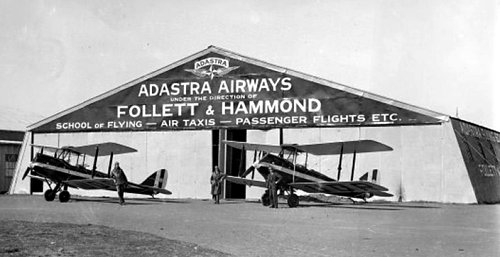
Where
it all began. Adastra's first two aircraft, Gipsy Moths VH-UOQ
and VH-UOR in front of Hangar 8 at Mascot around the time
that Adastra opened for business in August 1930. [Click on image for a full screen view] |
|
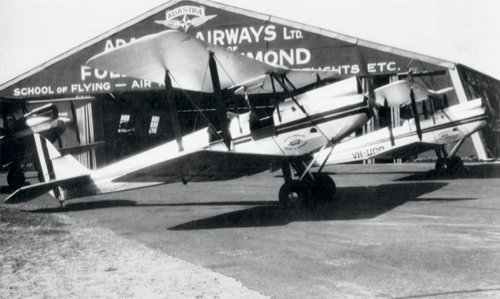
Adastra's
first two aircraft, Gipsy Moths VH-UOR and VH-UOQ in front
of Hangar 8 at Mascot. [Click on image for a full screen view] |
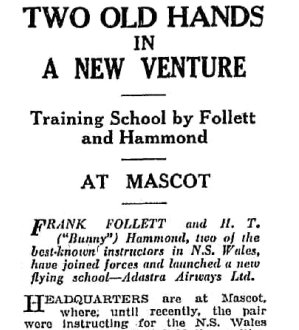
The company was registered as Adastra Airways Ltd in Sydney, Australia on 18th August 1930 by Captain Frank William Follett (1892-1950), his sister Miss Evelyn Mary Follett (1902-1977) and Group Captain Henry Talbot "Bunny" Hammond (1894-1982). Soon after, the company began operating as the Adastra Flying School at Mascot Aerodrome in Sydney. The name Adastra is derived from the motto of the Royal Air Force and Commonwealth air forces including the Royal Australian Air Force. The full motto, which dates from 1912, is Per ardua ad astra which translates from the Latin as Through adversity to the stars. As Frank Follett and Bunny Hammond had served in the Australian Flying Corps it was a fitting basis for the name of the new company. Bunny Hammond and Evelyn Follett also served in the RAAF. Hammond had earned his nickname "Bunny" from his attempts to tunnel out of a German POW camp during WW1.
 |
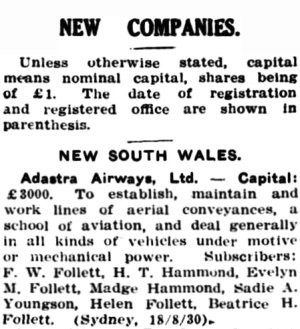 |
Press
reports announcing the formation of the new company.
(Click on either image to read both articles)
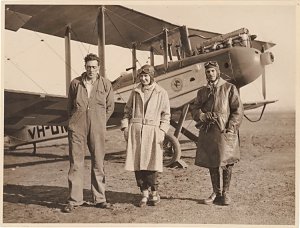
|
Two
of Adastra's founders, Miss Evelyn Follett (centre) and Captain
Frank Follett (right).
(Photo: Hood Collection SLNSW) (Click for a larger image with explanatory caption) |
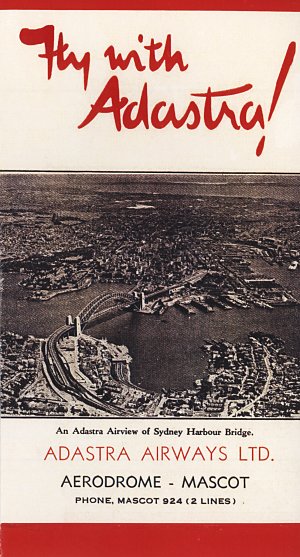
|
An
early Adastra promotional brochure. (Click for larger images of the entire brochure) |
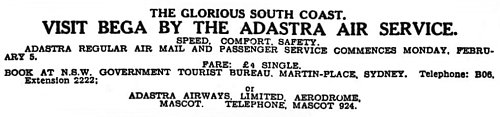
Adastra Airways Ltd commenced
a subsidised passenger and air mail service from Sydney to Bega, NSW
on 5th February 1934 using Fox Moth VH-UQU. The service operated twice
weekly departing at 0830 and returning at 1630. From the 20th May
1935, Nowra NSW was included as a stop. On 14th April 1936 VH-UQU
collided with a D.H. Moth during take-off although the pilot Mr Beverley
Shepherd and passengers were not injured. The Fox Moth was subsequently
rebuilt. In February 1937 the company imported the Waco YKS6 VH-UYD.
In April 1938, the Dragonfly VH-AAD was added to the fleet. During
July 1937 the Civil Aviation Board considered withdrawing subsidies.
The service ceased on the 24th August 1940 to be taken over by Butler
Air Transport Co.
On the 8th December 1934 shark patrols of Sydney's beaches commenced
using an aircraft supplied by Adastra Airways Ltd. The aircraft was
christened "McWilliams" by the General Manager of radio
station 2UW. The aircraft was flown by a 2UW staff member, E.V. Collibee,
who would transmit messages to 2UW for relay to the nearest lifesaving
club. Radio equipment was temporarily fitted in the forward cockpit
and a lifebuoy was carried for dropping to swimmers in difficulty.
Although aircraft were sourced from other operators as well, it was
an Adastra Moth VH-UOQ which crashed into the sea off Cronulla on
10th February 1935 after engine failure during a lifesaving demonstration.
In November 1935 the Minister for Defence announced that the government
would permit the importation of American and German aircraft. Several
Australian operators became agents for American manufactureres and
included amongst these was Adastra which secured the agency for Waco
aircraft.
In April 1936 Captain Frank Follett and Norman Rodoni of Adastra Airways
carried out a survey of the Cobar, NSW district in a British Aircraft
Eagle under instruction from the NSW Department of Mines. The was
the first occasion that an aircraft had been used in NSW to assist
ground parties in mineral surveys.
In 1944, Frank Follett formed Adastra Aerial Surveys and began operations
with a fleet of Avro Ansons. The first Hudson to join the fleet (VH-AGG
named "Frank Follett") was acquired from the famous speedway motorcycle
rider and George Medal winner, Lionel
Van Praag, who later joined Adastra as a pilot and subsequently
became Chief Pilot.
On 31st October 1954, The General Manager of Adastra, H.T. Hammond,
announced the formation of Adastra Hunting Geophysics Pty Ltd. The
company would commence operations with a Percival Prince owned by
the Hunting Geophysics Company of London.
Adastra was purchased by
East-West Airlines on 1st April 1973 and its base and aircraft moved
to Tamworth. Adastra ceased operations shortly thereafter.
In 1976, Adastra was acquired
by Qasco (Queensland Aerial Survey Company Pty Ltd). The following
quote appears on the Qasco website:
"Adastra was the first
aerial photography company in Australia and had stored negatives of
photography exposed as early as the late 1930s. Much of this, as well
as the early Qasco photography, has been donated to state mapping
archives and libraries."
Qasco have advised that no other Adastra records remain in their possession.
In 2009, Qasco merged with Survey21 to form Vekta.
The Adastra Aerial Surveys banner which appears at the head of this
page shows the unique Adastra typeface which was applied to Adastra
aircraft (Hudson and later). This font was laboriously recreated,
one letter at a time, by former Adastra navigator Peter Shute.
|
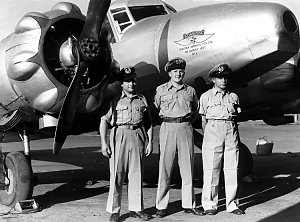
An
Adastra crew in company uniform
in the late forties. Photo: Jack Howard Collection [Click on image for a full screen view with explanatory caption] |
|
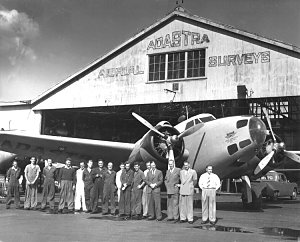
Adastra staff posing with
Hudson VH-AGX outside Hangar 15 at Mascot in 1954. Photo: Mike Wood Collection [Click on image for a full screen view with explanatory caption] |
|
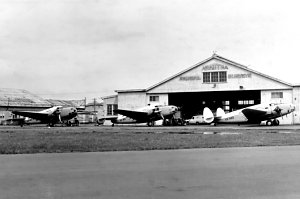
Three Adastra Hudsons outside Hangar 15 at Mascot
circa 1956.
Photo: Allen Windross [Click on image for a full screen view with explanatory caption] |
| ||||||||||||||||||||||||||||||||||||||||||||||||||||||||||||||||||

 |
|
|
|
|
 |
 |
|
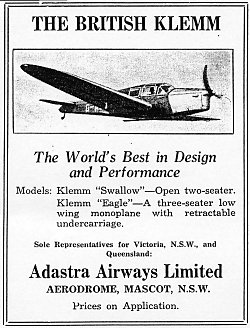
A
January 1935 Adastra advertisement for
British Klemm aeroplanes. (Contributed by Roger McDonald) |
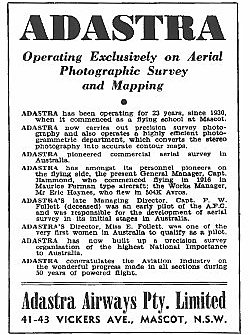
Adastra
commemorates the
50th anniversary of powered flight. (Contributed by Roger McDonald) |
|
|
|
 |
|
|
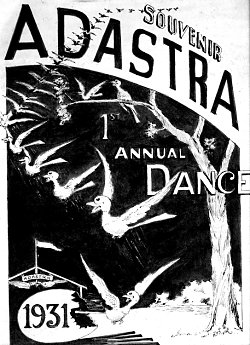
A souvenir from the first annual Adastra Dance in 1931. (Contributed by Jim McKnight) |
|
|
|
|
 |
|
|
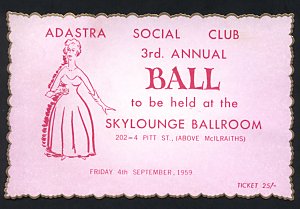
Ticket No. 138 for the Adastra Social Club Ball on Friday 4th September 1959. (Contributed by Bill Mitchell) |
|
|
|
|
 |
|
|
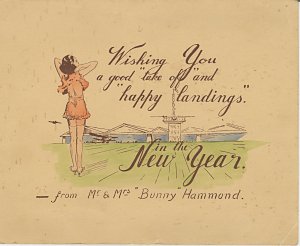
New
Year greetings from Mr & Mrs Bunny Hammond.
Unfortunately the year of issue is unknown. (Contributed by Lorraine Staniland) |
|
 |
 |
|
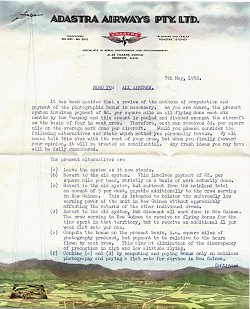
Adastra
letterhead 1958
|
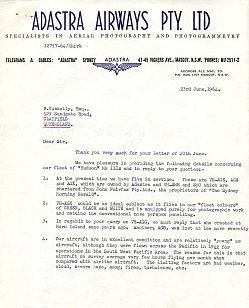
Adastra
letterhead 1964
|
|
Click
on above images for a full screen view. |
|

Click
on the image to download the Adastra Font.
Recreated by Peter Shute.
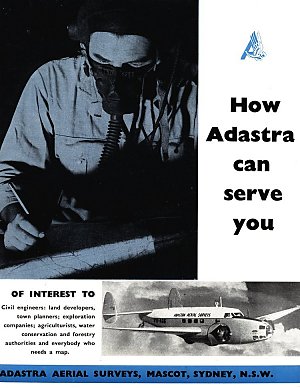
Adastra Aerial Surveys Sales Brochure.
[Click on image for a full screen view of all 8
pages]

Adastra
was visited by a photographer
from PIX Magazine on 2 March 1960.
Click for a selection of the photographs.
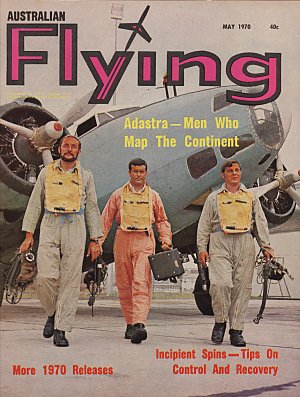
Australian
Flying of May 1970.
Reproduced with the permission of Australian Flying.
[Click on image for a full screen view of all 6
pages]
The Hudson
is VH-AGX. The personnel are (left to right)
Peter Shute (Navigator)
Geoff Dunn (Camera Operator)
Brian Costello (Pilot)
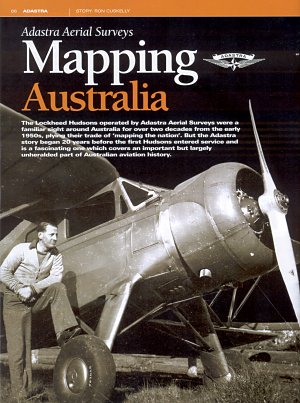
AERO Australia
Issue 5 of Jan/Mar 2005.
Reproduced with the permission of AERO Australia.
[Click on image for a full screen view of all
7 pages]
| Australian Aerial Survey Review | No 1 |
Summer
1958
|
| Australian Aerial Survey Review | No 2 |
Autumn
1958
|
| Australian Aerial Survey Review | No 3 |
Spring
1958
|
| Australian Aerial Survey Review | No 4 |
Missing
|
| Australian Aerial Survey Review | No 5 |
October
1959
|
| Australian Aerial Survey Review | No 6 |
May
1960
|
| Australian Aerial Survey Review | No 7 |
Missing
|
| Australian Aerial Survey Review | No 8 |
February
1962
|
| Australian Aerial Survey Review | No 9 |
December
1963
|
| Australian Aerial Survey Review | No 10 |
August
1965
|
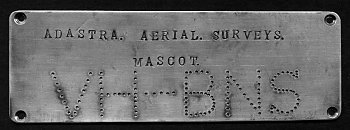
A plaque removed
from Anson VH-BNS
(Contributed by Geoff Goodall)
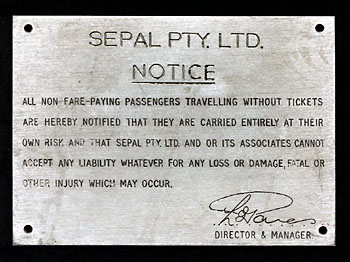
A plaque removed
from Hudson VH-AGP
during its restoration to military configuration.
(Click for a larger image)
(Ron Cuskelly Collection)
Sepal Reborn
The Vickers Avenue Doors

Adastra Hunting Geophysics emblem.
John Bertles
advises that he and Rick Boughton designed this emblem which is
based on the
Hunting winged horn. The "A" for "Adastra"
came from the front of an Ardath cigarette packet!