|
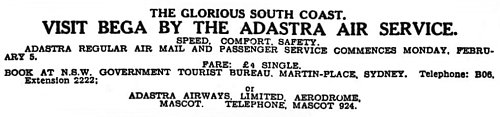
This advertisement appeared in the Sydney Morning Herald of 2nd
February 1934 to promote Adastra's new Sydney - Bega service which
was due to commence three days later.
On February 3rd, the Herald stated:
"A regular air service between Sydney and Bega will be commenced
on Monday by Adastra Airways, Ltd., of Mascot. The company is
being subsidised by the Federal Government, and will carry air
mail between the two centres. For a start the service will operate
on Mondays and Fridays. The company has purchased a new de Havilland
Fox Moth for the service. The 'plane will leave Mascot at 8.30
a.m., reaching Bega at 11 a.m. The return trip will be made the
same day, leaving Bega at 2 p.m. and arriving at Mascot at 4.30
p.m."
The day after the inaugural service, the Herald of 6th February
stated:
"The aerial mail service between Sydney and Bega was inaugurated
yesterday by Adastra Airways, Limited. The service, which is being
subsidised by the Federal Government, will be extended if the
demand for passenger accommodation and freight warrants. Yesterday
there was a fair number of packages of freight, as well as the
mail. Two machines were used. The De Havilland Fox Moth, which
is to be flown on the regular service, was piloted by Captain
Follett, managing director of the company, who was accompanied
by Captain Burgess, State Controller of Civil Aviation, representing
the Civil Aviation Department. This machine is fitted with a 130
h.p. Gipsy Major engine, and carries a pilot and three passengers.
The other machine, which will be used as a relief, is an ordinary
Moth and carries a pilot, one passenger, and freight. It was piloted
yesterday by Mr. Norman Adams. The aeroplanes left Mascot at 8.30
a.m., and arrived at Bega at 11.15. They left Bega at 2 p.m. and
arrived at Mascot at 4.15 p.m. At present, the arrangement is
for a two-way flight between Mascot and Bega on Mondays and Fridays."
The Fox Moth used on the inaugural service was VH-UQU. The identity
of the Gipsy Moth is unknown, but it was possibly either VH-UOQ
or VH-UOR. Other aircraft used on the service over the years included:
|
Waco YKS-6 VH-UYD
DH-90 Dragonfly VH-AAD
B.A. Eagle VH-UUY
|
The service continued until 11th
November 1940 when the route was taken over by Butler Air Transport. For further
details of the airline operation please refer to the chronology pages:
1930
- 1939
1940 - 1949
For photographs of the
aeroplanes used on the Bega service please refer to the Miscellaneous
Aircraft page.
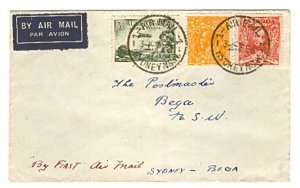
This Flown
Cover was carried on the
first Adastra Airways flight to Bega.
Courtesy:
Doug Morrison Collection

An Adastra
Airways Timetable from July 1938
Courtesy:
Roger McDonald Collection
"FROM BULLOCKS
TO BOEINGS"
The following recollections
from Lou Pares are drawn from an illustrated history of Sydney Airport titled
"From Bullocks to Boeings".
"At that
time (1935) under the Adastra flag, the Airline's main aircraft was a Waco single
engine biplane, fitted with a huge Jacobs radial motor. A lady who was around
10 to 11 stone (63-70 kg) and recovering from a heart attack booked a seat from
Mascot to Bega provided Captain Follett piloted the aircraft. Frank Follett readily
agreed as passengers were few and far between, but decided that the usual pilot,
Norman Adams, would actually fly the Waco whilst he sat in the second seat. Halfway
to Bega, things began to happen. Firstly Follett to Norm Adams: 'Norm, I think
you've just lost the damn prop.' Norm to Follett: 'I've got news for you Skipper,
we've just lost the whole damn engine!' In fact the complete engine had fallen
off the front of the aircraft, but without the 'sick' passenger being aware, Norm
Adams expertly landed the aircraft on Gerringong Beach and the two gallant aviators
carried the passenger to the township where she was conveyed by car to Bega. They
always said the Waco was the safest aircraft in our fleet - one Klemm Eagle, one
Dragonfly and the Waco."
Pares also
recalls the casualness of the young Australian airline in another incident relating
to Adastra - the sale of its Bega service to Arthur Butler in 1940.
"Arthur
walked into my office and said: 'What do you want for this tin pot air service
of yours?' We had heard that the subsidy was due to be removed shortly, so I went
into Frank Follett's office and said: 'Butler wants to buy the Bega Service.'
Follett's reply was: 'See if you can get £400 for it.' I proceeded with this highly
involved sale as follows:
Pares: 'We will sell it for £450.'
Butler: 'I'll give you £400.'
Pares: 'Sold.'
Butler: 'Here's the cheque. See you later.'
Deal closed."
"From
Bullocks to Boeings"
Author: Jennifer Gail
Publisher: Australian Government Publishing Service, Canberra,
1986
ISBN 0 644 03395 9
|

